Docs navigation
Architecture
YVEX System ArchitectureYVEX System Architecture
On this page
System contextSource to verified executionLogical planesInterpret and compileAdmit and executeProduce and integrateState and lifetime viewExecution and generation viewTrust and support viewSource ownership and dependency directionAuthority boundariesNext readsVerified source, compiled meaning and isolated computational execution.
YVEX turns exact upstream model sources into admitted computational execution. Its compiler seals meaning and physical work; its runtime owns engine/session lifetimes; its backends execute admitted operations. Evidence observes these boundaries without becoming an execution owner.
System context
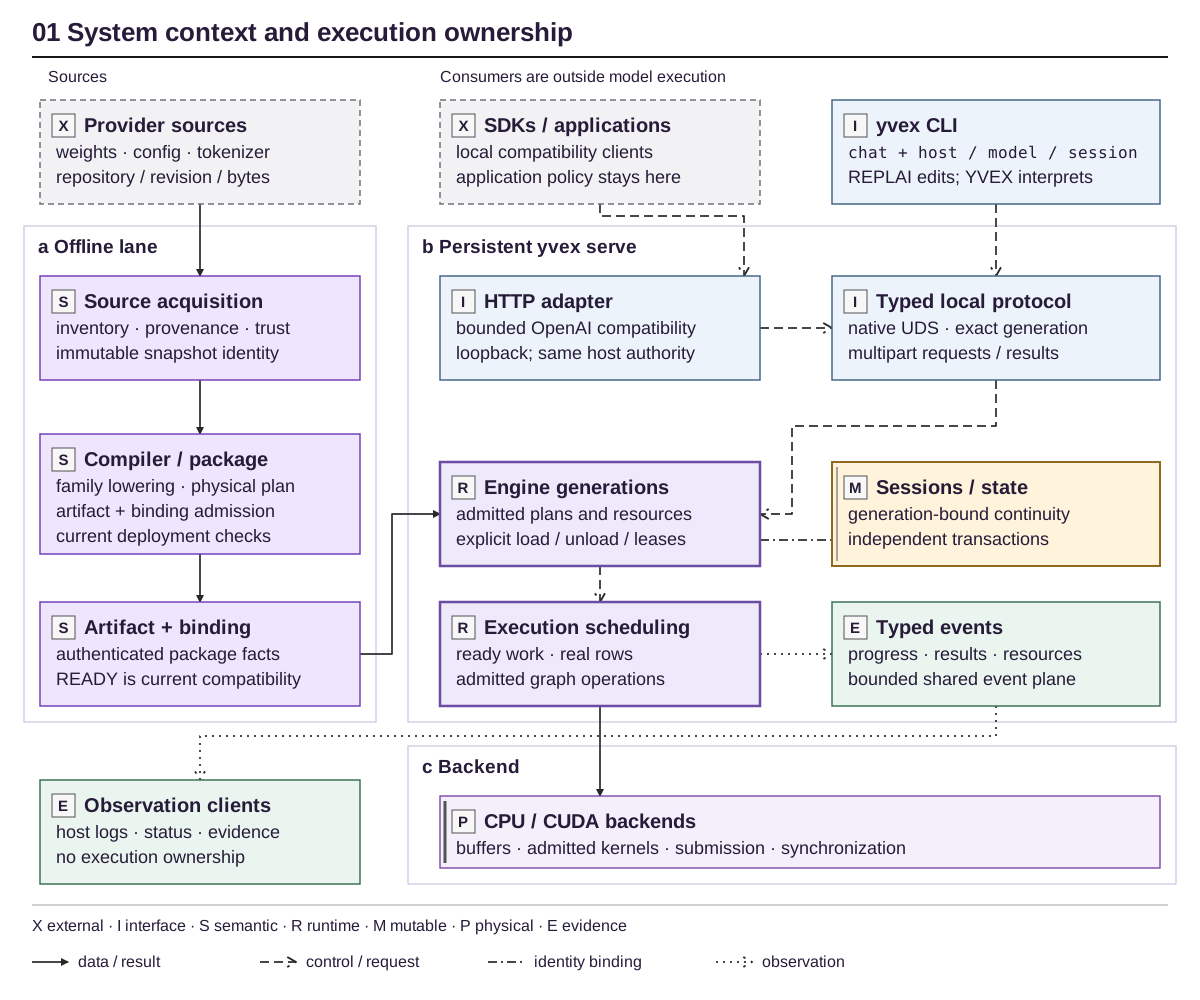
Static figure · Editable source

Editable context source. Operators, C consumers and application providers enter through typed interfaces. YAI owns semantic work outside this boundary. Hardware executes the admitted computation; a transport adapter does not confer additional model capability.
Source to verified execution
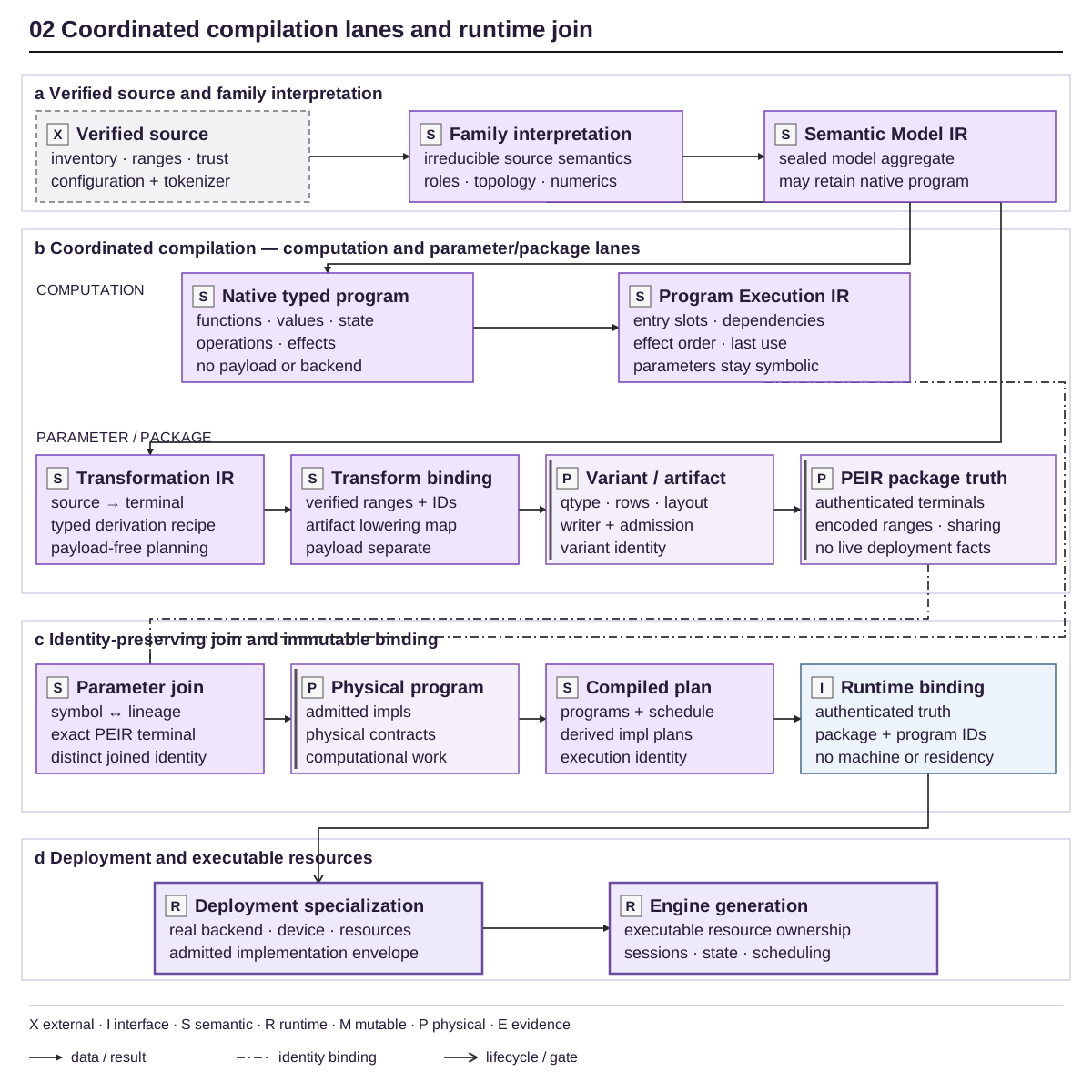
Static figure · Editable source

The signature lifecycle is a fork and join, not a linear IR-to-GGUF conversion:
- Source and family interpretation authenticate provenance and interpret model meaning.
- Computation lane seals semantic/program IR and lowers legal operations.
- Parameter lane derives transformations, quantization, layout and an admitted artifact.
- Parameter join binds symbolic computation to exact package terminal truth.
- Deployment admits numerical/implementation classes and resource requirements.
- Engine generation owns immutable executable resources; sessions own state.
- Scheduler and backend select real ready work and execute admitted operations.
- Result and evidence publish only after the required identity/lifecycle checks.
Logical planes
Interpret and compile
- Source and Provenance — Authenticate the exact source before interpreting or executing it.
- Model Semantics and Admission — A family interprets a model; shared machinery owns its execution lifetimes.
- IR and Compilation — Seal computation and parameter lineage before runtime allocation.
- Representation, Quantization and Artifacts — A logical model can have several exact physical representations.
- Artifact and Package Admission — Authenticate a complete package before publishing a usable mapping.
Admit and execute
- Deployment and Specialization — Admit an implementation and resource envelope without changing artifact identity.
- Engine and Session Runtime — A host retains engines; each session owns independent mutable execution.
- Computational State — Sessions isolate state; transactions coordinate publication across distinct geometries.
- Scheduling and Resources — Schedule real ready work and account for resources without inventing physical width.
- Backend and Device Execution — Execute admitted work; do not rediscover model semantics in kernels.
Produce and integrate
- Generation and Decoding — Generate tokens through compiled model work and transactional publication.
- Speculation and Finite Execution — Shared runtime machinery supports distinct result semantics.
- Interfaces and Protocols — Clients project typed system behavior without acquiring execution ownership.
State and lifetime view
| Object | Owns | Survives / expires with |
|---|---|---|
| Source snapshot | Exact provenance and tensor basis | Immutable source identity |
| Logical model/program | Interpreted computation and legal effects | Compiled identity |
| Representation/artifact | Exact encoded parameters and package facts | Authenticated stored bytes |
| Deployment specialization | Admitted implementation and resource choices | Compatible hardware/workload envelope |
| Engine generation | Executable resources and stale-reference boundary | Load/unload/drain |
| Session | Mutable attention/recurrent/component state | Session lifecycle and its parent generation |
| Transaction/result borrow | Candidate publication and transient value validity | Atomic commit/abort or producer reuse |
Captured prefixes are identity-bound snapshots, not generic semantic memory. Persistent cognitive state E and unfinished deliberation L remain research. A client disappearing does not transfer or destroy host authority; cancellation and retirement follow the runtime contract.
Execution and generation view
The scheduler chooses ready progress. An execution batch records actual selected rows; an expert worklist groups their routed populations. CUDA owns buffers, submission, synchronization and equivalent launch geometry below admitted execution. It does not infer topology from a family name or tensor dimensions.
Ordinary generation runs tokenizer/admission → prefill → decode/logits → sampling → transactional publication. Speculation adds target verification; finite readout supplies candidate tokens instead of sampling; native finite models compute typed results directly. Media composition uses admitted component programs, not a second generic runtime.
Trust and support view
“Supported model” means a bounded combination of source, representation, deployment, execution and evidence. Family recognition, a complete artifact, component numerics, model behavior and release qualification are separate gates. Missing semantics, stale generations and unsupported exact requests fail closed.
See Invariants, Contracts, family evidence and current Status.
Source ownership and dependency direction
Core/public ABI → source/artifact/model/tokenizer → compiler/graph → materialization/runtime → backend → generation → evaluation. Domain facts flow through typed reports to renderers and CLI I/O.
Authority boundaries
| Boundary | Current owner |
|---|---|
| Source provenance, inventory, payload trust | src/source/ |
| Remote provider discovery and remote representation records | src/accounts/, src/model/remote.c, include/yvex/catalog.h |
| Local acquired-source and admitted-package catalogs | src/model/catalog.c, src/model/artifacts/, include/yvex/catalog.h |
| Family source facts, coverage and logical lowering | src/model/families/ |
| Authenticated finite-frontier text/token construction | src/tokenizer/finite_input.c and source-owned recipes under src/tokenizer/families/ |
| Artifact-neutral parameter transformation, transform binding and representation policy | src/model/compilation/, model compilation owners |
| GGUF container, qtypes, writer, layout | src/gguf/ |
| Artifact snapshot, integrity, admission, bounded ranges, and package mapping/materialization session | src/artifact/, include/yvex/internal/artifact.h |
| Backend/model executable weight materialization | src/model/materialization.c, include/yvex/materialization.h |
| Semantic Model IR, native typed programs, execution lowering, physical programs and state protocols | src/model/compilation/, src/ir/, src/graph/ |
| Runtime binding, model engines, specialization, sessions, residency, scheduler | src/runtime/ |
| Device capability, memory, kernels, launch graphs | src/backend/ |
| Autoregressive composition | src/runtime/generation.c and typed generation owners |
| Persistent host, live engine observation, routing, protocol, telemetry | src/server/ |
| OpenAI-compatible projection | src/server/openai/ and src/provider/ |
| Command metadata and projections | config/operator/registry.json, generated descriptors, src/cli/ |
Family source interpretation and graph recipes occupy separate compilation levels, described by family integration. Generic runtime and backend owners consume typed plans, not family-name switches. Pure-SSM execution now has the exact CPU boundary documented by the Mamba2 record; this does not imply hosted conversation or CUDA SSM support.
The exact source-file ownership manifest is
config/source_owners.tsv. It is also the
sole handwritten production build-membership list; a checked deterministic
projection supplies Make product classes. Contributor-facing layout and build
ownership rules are in
Source and Module Ownership.
Next reads
docs/architecture/README.mdRead on GitHub